Research in the MIND Lab
Overview
Research in the MIND Lab seeks to explain the dynamics of human memory – how it works, and why it sometimes fails us – through a combination of behavioral experiments and computational modeling approaches.
Research Areas
When and why memories lose specific details
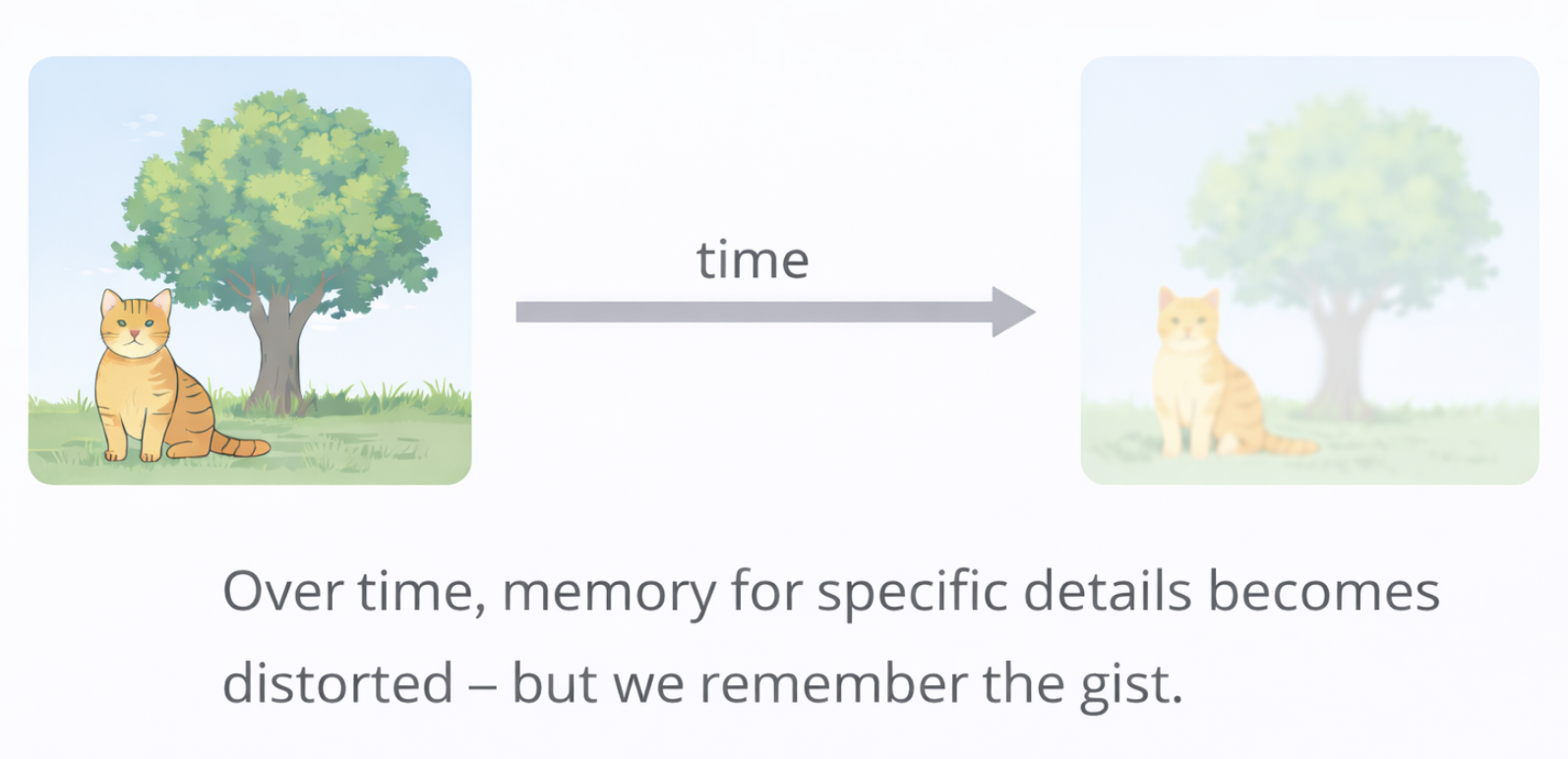
Our memories are rarely perfect portrayals of our past experiences. Do you remember exactly what was said in a conversation you had yesterday, or what color shirt your friend was wearing? Chances are, those specific details are gone, even though you still remember what the conversation was about.
This is a feature, not a bug, of human memory: preserving the core essence or gist of our experiences helps us make sense of the world. But there are also situations in which access to specific details matters—such as when taking an exam or remembering whether you took your medication today. What determines whether those details are available?
We study the conditions under which episodic memory preserves fine-grained details versus collapsing to gist-level information. Across paradigms, we ask what representational content is available at retrieval, and what mechanisms constrain access to specific details when they matter. In this work, we consider the roles of factors such as attention, working memory demands, processing speed, and retrieval dynamics in shaping whether memory supports detailed versus more generalized representations.
Selected publications - Greene & Naveh-Benjamin, 2022 - Greene & Naveh-Benjamin, 2024
Attention, working memory, and long-term memory
We examine how attention and working memory shape what becomes durable in long-term memory—especially under conditions of overload, distraction, or competition. This work connects classic capacity limits to downstream consequences for memory precision and generalization.
Selected publications - Greene, Guitard et al., 2024 - Cowan et al., 2024
Metamemory and memory specificity
We explore the relation between people’s objective memory strengths and their perception of their memories, particularly in situations requiring people to remember specific details. We aim to understand how the memory-metamemory relation evolves across the human lifespan.
Selected publications - Greene, Forsberg et al., 2024 - Greene, Chism, & Naveh-Benjamin, 2022
Research Methodologies
Behavioral Experiments
Computational Modeling
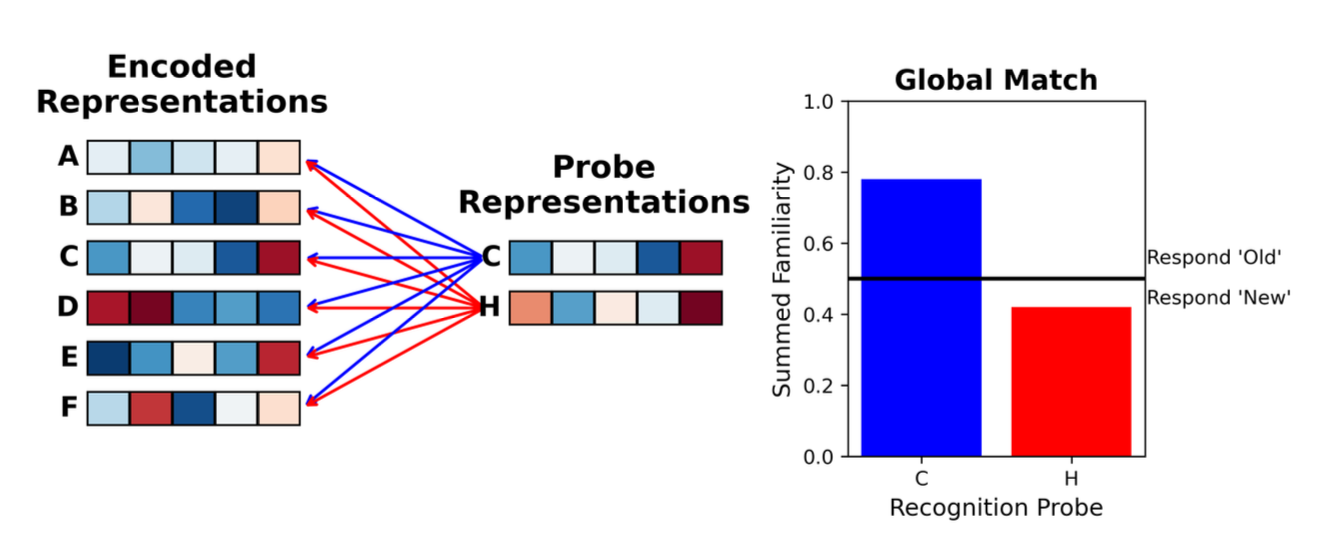
One challenge in studying memory is that we cannot directly observe each other’s memories. Addressing this challenge requires innovative solutions, and computational modeling provides a powerful path forward.
In a computational model, we use the universal language of mathematics to formalize how information is encoded, represented, and retrieved from memory. By building explicit models of how memory is assumed to operate, we can test whether those models reproduce the behavior of real participants in memory experiments. This approach allows us to move beyond description and more precisely identify the mechanisms that help explain why memories often dispense with specific details—and to predict when this is likely to occur.
Modeling age differences in memory
A major objective of the MIND Lab is to leverage computational models to identify mechanisms of age-related memory change. Our approach builds on the successes of established models of memory, including global matching models (e.g., MINERVA2, SAM) and retrieved-context models (e.g., TCM, CMR2). These models have been highly successful in explaining the dynamics of recognition and recall in young adults, yet their application to questions of healthy aging has been comparatively limited. We adapt and extend these models to examine how changes in representational quality, retrieval dynamics, and processing constraints can give rise to age-related differences in memory specificity.
See our recent preprint:
Greene, Guitard, & Naveh-Benjamin — Process Explanations of Age-Related Changes in Memory Specificity
For an interactive demo of the operations of a retrieved context model, click through below:
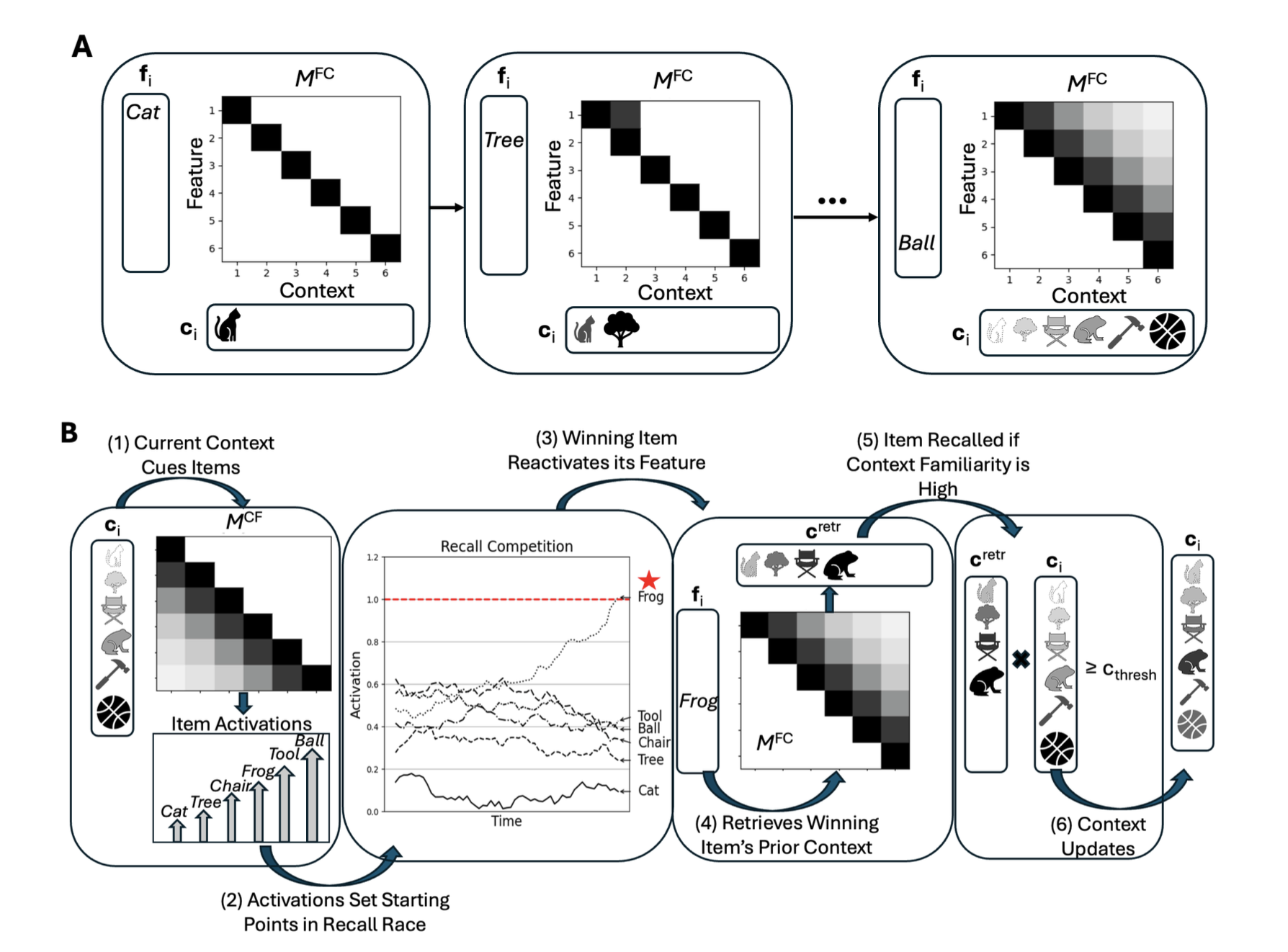
Click through to see how encoding and retrieval unfold in a retrieved-context model.